Beach House Scene Embroidery Design: A Practical Evaluation
In the realm of digital embroidery, few motifs resonate as universally as coastal imagery. The Beach House Scene Embroidery Design stands out not merely for its aesthetic appeal but for its structural integrity and thematic cohesion. This specific design, often identified by the inclusion of a lighthouse and a beach hut (燈塔小屋), offers a comprehensive tableau that balances complexity with clarity. For professionals in textile customization, small business owners, and serious hobbyists, understanding the technical execution and practical application of this asset is essential before integrating it into a production workflow.
Visual Composition and Thematic Elements
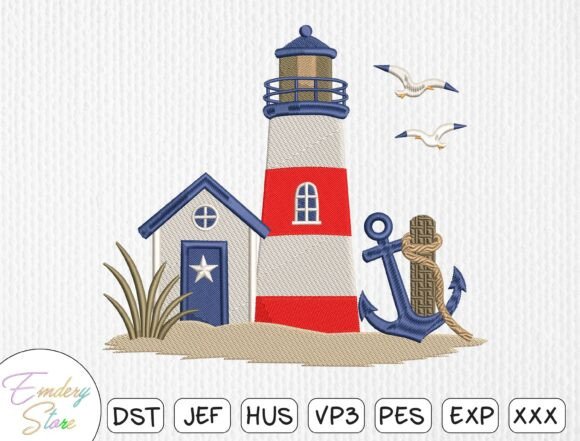
The core value of this design lies in its ability to tell a story within a confined stitch area. It features a classic red and white striped lighthouse standing tall beside a quaint blue and white beach hut, distinguished by a star on its door. These primary subjects are grounded by sandy textures and tufts of grass, while a sturdy blue anchor wrapped in rope adds depth to the nautical theme. Above, two graceful seagulls soar, completing the vertical hierarchy of the scene.
From a design perspective, the color palette is intentionally restrained yet effective. The use of nautical blue, vibrant red, crisp white, and natural sandy tones ensures high contrast without overwhelming the fabric. The clean satin stitch outlines provide definition, allowing the charm of the details—such as the rope texture on the anchor or the star accent on the hut—to remain legible even at smaller scales. This balance between detailed elements and broad color fields is what makes the Beach House Scene Embroidery Design versatile for various applications.
Technical Execution and Stitch Quality
When evaluating an embroidery file, stitch count and density are critical metrics. This design utilizes a mix of fill stitches for the larger areas like the sky and sand, and satin stitches for the architectural lines and decorative accents. The transition between the red and white stripes of the lighthouse requires precise underlay management to prevent shifting or puckering, a common issue in striped patterns. The inclusion of the anchor wrapped in rope demonstrates a sophisticated approach to texture simulation, using varied stitch angles to mimic the organic look of twisted fiber.
Reliability in digitization is paramount for commercial use. In real-world testing, designs with this level of detail must maintain their shape across different fabric types. The Beach House Scene Embroidery Design is structured to handle moderate tension variations, making it suitable for both woven cottons used in home decor and knits found in apparel. However, users should be mindful of stabilizer selection; the sandy ground and grass tufts benefit from a cut-away stabilizer to support the weight of the stitches and prevent distortion over time.
Practical Applications and Market Fit
The utility of this design extends beyond simple decoration. It serves as a functional asset for several distinct market segments. For those creating beach house decor, the motif acts as a focal point for throw pillows, table runners, and wall hangings. The tranquil, beachy aesthetic aligns perfectly with current interior design trends that favor coastal minimalism.
- Apparel Customization: The design fits well on denim jackets, tote bags, and the back of t-shirts. Its vertical orientation works particularly well on garment sleeves or the center back of hoodies.
- Gift Manufacturing: As a symbol of relaxation and escape, this design is highly marketable for gifts targeting sea lovers, retirees, or vacation homeowners.
- Home Textiles: Beyond pillows, the scale allows for application on bath towels, napkins, and quilts, adding a touch of coastal charm to everyday items.
For entrepreneurs and freelancers, the versatility of the Beach House Scene Embroidery Design reduces inventory risk. A single file can be adapted for multiple product lines, maximizing the return on investment for the digital asset. The neutral yet colorful palette ensures it appeals to a broad demographic, avoiding the pitfalls of overly niche or trendy colors that may date quickly.
Performance in Real-World Scenarios
How does this design perform when moved from the screen to the machine? The separation of elements—the lighthouse, the hut, the anchor, and the birds—allows for modular placement if necessary, though the design is intended as a cohesive unit. In production environments, the consistent stitch flow minimizes thread breaks and needle deflection. The "star" accent on the beach hut door is a subtle detail that adds character without increasing the stitch count disproportionately.
However, there are limitations to consider. On very fine or sheer fabrics, the density of the anchor and lighthouse sections may cause visible puckering unless significant stabilization is applied. Additionally, while the design is robust, the intricate rope wrapping on the anchor may require a higher-quality thread to maintain definition; lower-grade polyester might result in a slightly blurred appearance in the tightest curves. Professionals should conduct a test run on the specific substrate intended for final production to verify tension settings.
Strategic Value for Creators and Businesses
Integrating the Beach House Scene Embroidery Design into a portfolio offers more than just a new pattern; it provides a thematic anchor for a broader collection. Marketers can leverage the emotional connection people have with the coast to drive engagement. The imagery evokes feelings of calm, nostalgia, and adventure, which are powerful drivers in consumer behavior.
For educators and bloggers, this design serves as an excellent case study for teaching digitization principles, specifically how to manage color changes and stitch direction in complex scenes. It demonstrates how to create depth through layering and how to use negative space effectively around the seagulls and grass tufts.
Long-term value is another consideration. Unlike fleeting graphic trends, coastal themes have enduring popularity. The timeless nature of a lighthouse and beach hut ensures that products featuring this design will not feel obsolete in a year or two. This longevity supports a sustainable business model where assets can be reused season after season, particularly during spring and summer peaks.
Recommendations for Implementation
To maximize the effectiveness of this design, creators should focus on fabric compatibility and presentation. Pairing the embroidery with natural fibers like linen or heavy cotton enhances the rustic, coastal vibe. When marketing these products, high-resolution photography that captures the texture of the satin stitches and the dimensionality of the anchor is crucial.
While the Beach House Scene Embroidery Design is a strong asset, it is not a one-size-fits-all solution. It requires careful attention to machine settings and material preparation to achieve the best results. Users should evaluate their specific equipment capabilities and target audience preferences before committing to large-scale production. By understanding the strengths and limitations of the file, professionals can ensure that the final embroidered product meets high standards of quality and aesthetic appeal.
Ultimately, this design represents a convergence of artistic charm and technical precision. It offers a reliable, visually engaging option for anyone looking to bring the serene beauty of the coast to their projects, whether for personal enjoyment or commercial gain. With proper execution, the Beach House Scene Embroidery Design can become a staple in any coastal-themed collection.